Beautiful daily rituals.The warmth of paper journaling, on iPhone and iPad.

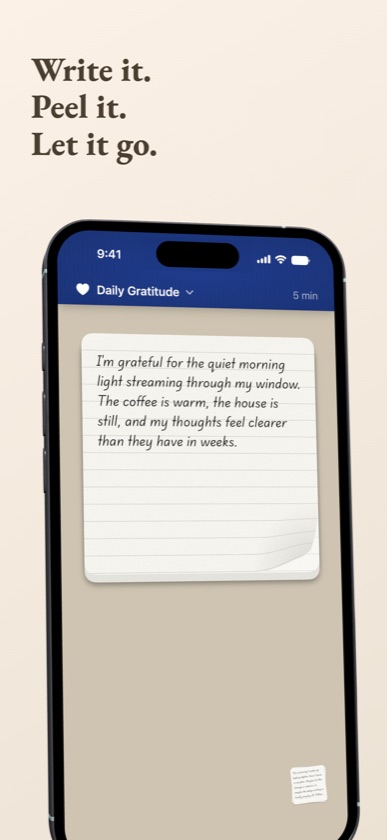
This little notepad is real. Stop for a second and the corner curls; tap the curl (or press Cmd/Ctrl+Return) and the page peels away with your words on it. Tap the torn-off note to open it as a card you can share. Nothing you type is saved or sent anywhere.

Download on the App Store

For people who believe writing changes you. No algorithms, no social feeds. Just you, your thoughts, and the warmth of paper.

The method

Writing that actually works

A diary and a writing protocol are two different things. Inkput is built around the second: structured methods out of psychology research, guided a step at a time.

Pennebaker Method

Expressive writing, with two hundred peer-reviewed studies behind it. The same difficult experience, four times, fifteen to thirty minutes each, without stopping. For your eyes only. Typing works as well as pen and paper; the science doesn't care about the medium.

Daily Gratitude

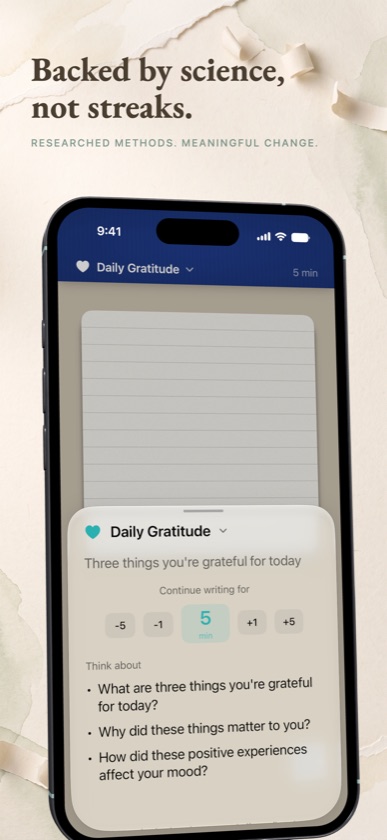
Short, structured thankfulness. Instead of a blank "what are you grateful for?", Inkput asks for something specific enough to picture. That is the kind research ties to a mood that holds, rather than a glow that is gone by morning.

Ideation Sessions

Time-boxed brainstorming on paper. Set a question, start the clock, keep the pen moving. The clock is the point. Ten minutes you can't stretch will pull more honest ideas out of you than a note you can always come back to.

Free Writing

No structure, no timer, no prompts. Sometimes you just need paper. Everything else in Inkput gets out of the way.

The session

Writing with a beginning and an end

Every page you write belongs to a session: one sitting, one method, one clock. Start it, fill as many sheets as it takes, and close it when you're done. What you wrote stays together as one thing, with a name, a shape, and a way back to it.

Gratitude Journal

What are three things you're grateful for today?

the long way home,and nobody waiting

It really does run five minutes. Tap the tape if you'd rather skip to how it ends.

  1. Pick a method, take a clock

    Gratitude runs five minutes, Ideation ten, the Pennebaker Method fifteen. Free writing has no clock at all. Whichever you pick, the prompts come one at a time, so there's only ever one thing in front of you.

  2. Fill as many sheets as it takes

    Every page you peel off joins the session. Step away and it pauses; while it runs, the tape keeps time on your Lock Screen, so you don't have to hold the app open to hold the session.

  3. Close it, and it becomes something

    A finished session gets a name, a line of numbers (method, minutes, sheets, words), and a sphere that takes its color from the tone of what you wrote.

The long way home

Daily Gratitude · 5 min · 3 sheets · 214 words

Color drifts inside the glass like weather: amber when the writing is reflective, indigo when it's balanced, teal when it lifts.

Seal it, and wait

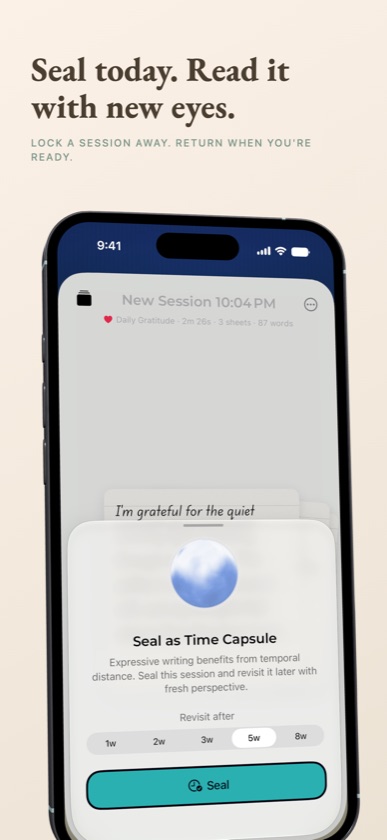
Lock a session away for one, two, three, five, or eight weeks. It sits in your journal as a sealed sphere, counting down. Nobody can read it, you included, until the day it opens.

1w2w3w5w8w

Or answer it later

Open an old session and write a new one against it: what stands out now, how you feel reading it, what has changed. The two stay linked, so you can follow a thought across months.

The craft

Made to feel like paper

A cover with real character

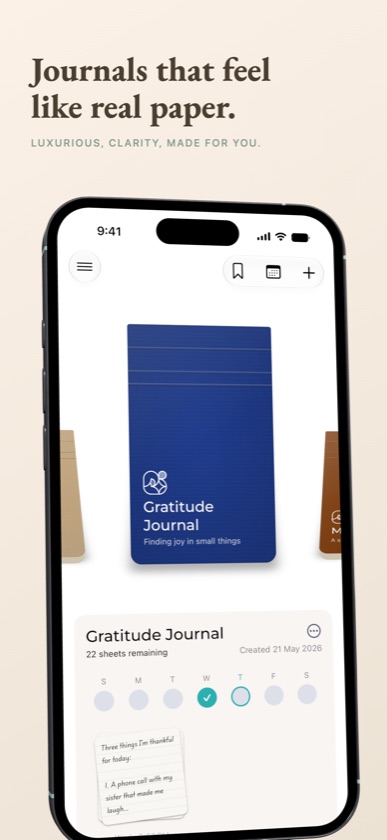
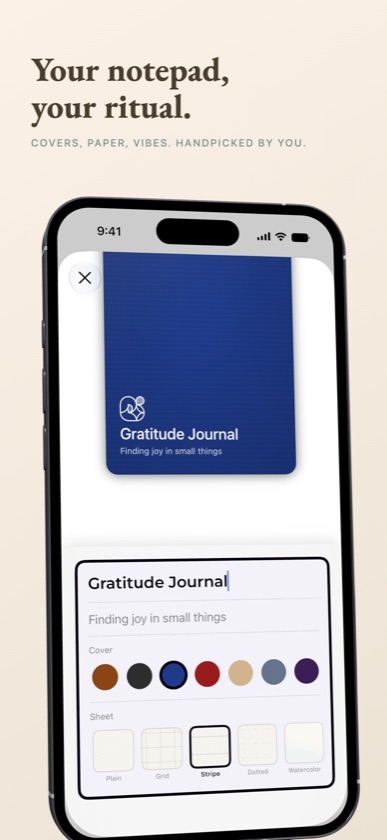
Seven colors on covers you can feel: leather, cloth, kraft. Name it, color it, make it yours. This little one works, go ahead.

Paper the way you like it

Five kinds of paper: plain, grid, stripe, dotted, and a soft watercolor wash. The right one makes you want to write on it.

Finish a page, peel it off

The corner curls when you're done, and you peel the sheet away with your finger. Ending a session is a ritual, not a tap on "Done". You already met this one up top.

Some pages aren't for keeping.

Not every page is for keeping

Some pages you write just to be rid of. Tear one across, tear the pieces again if you like, then throw them away — the words go with them. Nothing is gone until you throw: back out at any point and the page comes back whole. This one is real too.

Thirty sheets, like a real notebook

Each journal holds 30 pages. When it's full, you start a fresh one. Running out is the point: it's what makes finishing one mean something.

In the app

At home on your iPhone

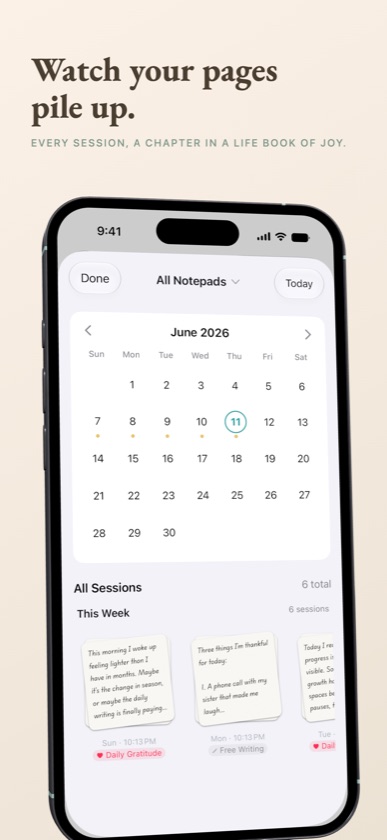
Writing screen: a square cream sheet with handwriting, corner curling, ready to peel. Notebook carousel: covers in navy, kraft and leather with session details below. Guided writing protocols: Pennebaker, Gratitude, Ideation and Free Writing. A sealed session shown as a misty sphere: the time capsule. Calendar view of past writing sessions. Customize screen: cover colors and sheet styles.

Privacy

Private by design

Your journal lives on your device. No accounts, no data collection, no tracking. Inkput doesn't have a server to send your words to. iCloud sync is opt-in and stays inside your private iCloud, readable by no one but you. Your thoughts belong to you alone.

From the maker

Why Inkput exists

Writing has always been hard for me. Facing a blank page, my head is a tangle. But every time I actually get the words out, the knot loosens and my thoughts go clear. I knew it worked. I just couldn't keep it up. Apple Notes, paper notebooks, every journaling app I could find: none survived two weeks.

Then an Andrew Huberman episode on journaling flipped how I thought about it. A diary and a protocol called Pennebaker expressive writing are two different things, and the second has more than two hundred peer-reviewed studies behind it. Write about the same hardest experience, four times, fifteen to thirty minutes, don't stop, for your eyes only. One detail answered my engineer's doubt: typing works as well as pen and paper. The science doesn't care about the medium.

So why had no app been built around it?

I'm an iOS developer, so I built it myself. My first commit wasn't a data model or a list screen. It was an ink sphere drawn with a Fourier curve. Then a marble shader, a rotating stack of cards, a pile of gesture toys. For weeks I didn't touch the journal feature at all, because I knew early on that this product's value isn't that it records things. It's a feeling: the warmth of paper. Get that right, and the product grows out of it.

Seventeen months and 425 commits later, those experiments became Inkput.

Somewhere along the way I realized that building an app to help people slow down forced me to learn how to slow down. The nights a shader wouldn't render, the week it crashed on every launch, the font I nudged by four points over and over. It's all the same act as journaling: taking something tangled and writing it, pass after pass, into something ordered.

Inkput is small, and it's niche. It's for people who believe writing changes you. If that's you, it's waiting.

— Victor the full build story is on Threads →

A quiet place to write. It's on the App Store.

Download on the App Store Inkput - Mindful Journaling | Product Hunt